Tuesday, 11 December 2012

Putting the 'organ' in organic


I’m hoping to win a few converts here to the wonderful world of organ meats.  Now I like prime rib and tenderloin as much as the next guy, but there’s a whole lot more to an animal than what gets packaged and sold at Costco.  Now I never grew up eating a lot of organ meats.  My mother would cook liver once in a blue moon because she figured it was healthy, but I don’t think either of us liked it all that much.  But lately, I’ve been experimenting a lot with cooking other organs (heart, sweetbreads, tongue, etc.) and have found that they’re not ‘offal’ at all, but can be quite good.  Here are some reasons to give it a try:

  1. They’re packed full of nutrients, vitamins, minerals and amino acids. 
In many cases, they’re much more nutrient-dense than more traditional cuts of meat.  Perhaps this is why they were held in such high esteem in the diets of many traditional cultures, and why predatory animals tend to eat the livers and organs of their prey first.  Here’s a good article outlining some of the particular nutritional strengths of various forms of offal, over at Mark's Daily Apple.

There’s also a good article over at the Weston A. Price Foundation, that talks about some of the, admittedly anecdotal, evidence behind organ meat consumption from a fitness/health perspective.  Bucking the bodybuilding trend in the 1980s toward low-fat everything, bodybuilder Ron Kosloff said, speaking about his grandparents’ longevity on a fat-heavy diet, “What astounded me most was their farmhand who went by the name of Indian Joe. When I first saw him he looked in his 40s and was incredibly cut and muscular. He looked like Conan. I was shocked when I found out he was well into his 70s. Indian Joe lived to 115 years of age and ate nothing but meat, glands and intestines!"

  1. They’re soooo cheap!
I prefer to buy meat that’s grass-fed and local, whenever possible.  That means shopping mostly at farmer’s markets, CSAs, etc. rather than the supermarket.  But that certainly gets pricey.  While I have absolutely no issue supporting farmers who are using good, sustainable practices, treating their livestock well, by paying a premium for their product, that doesn’t prevent me from capitalizing on the law of supply and demand.  The fact is that demand for organ meats is quite low, so the prices are always very low.  In some ways it seems that farmers are just trying to get rid of this stuff at cost.  I almost feel bad about paying so little.  I mean, check out some of the prices I’ve paid recently for livers, hearts and tongues.  Keep in mind that this is organic, pastured, locally-produced meat – cheaper than the worst processed shit (hotdogs, etc.) you’d find in a grocery store:


Are you kidding me?!  These are big chunks of meat (enough for at least two meals) for under one dollar!

  1. Properly prepared, they can be really delicious
I’d recommend the following book for recipes, called Odd Bits.  Some of the recipes in it are labour intensive, but I’ve made a few that are quite easy (I’m no chef!).  And of course there are a tonne of excellent recipes on the internet at various Paleo/Primal sites, as well as more traditional cooking sites.
Just last weekend, I made a recipe for tongue tacos that I found over on the Crossfit main page a couple weeks ago.  They turned out phenomenal!  Made with pineapple, and served in lettuce leaves, the slow-cooked tongue had the consistency of pulled pork when it was finished. It was my first attempt at cooking tongue (I know, technically a muscle and not an organ), and I’ve since made other good recipes with it as well - like this batch of green curried beef tongue earlier this evening.


Heart is really versatile and can be prepared like a lot of other lean meats.   I made Moroccan heart kabobs (based on a recipe in Odd Bits) a couple of months ago that turned out really well.

Sweetbreads (pancreas) are really quite good.  I’ve only cooked them a couple of times, stir-fried with green vegetables and spices, and they end up taking on a very similar texture to General Tao’s chicken.


Liver is tricky, as it has a tendency to dry out.  I’ve had the most success with grilling it quickly with a bunch of onions, garlic and pancetta/bacon for extra fat.  I eat it quite often (because of availability) but am still trying to come up with the best way to do it.

There are many other options of course.  I always order tripe when I’m out for Chinese dim sum, but haven’t ever tried cooking it at home.  I love both haggis and blood sausages as well, but have yet to try making my own.  I hope to change that in the near future.

The final point that could be made, in addition to the aforementioned cost-savings and nutritional benefits, is that eating organ meats is sustainable (in the whole ‘snout to tail’ sense of making use of the whole animal).  I always think it’s important to remember that the animal you’re eating gave its life for you (not exactly voluntarily, but nonetheless!).  I’m cognisant of this, not just as a hunter and a fisherman, but also as a consumer.  In some small part it seems that eating organ meats is a gesture, amidst a culture that is quite often wasteful, in support of a more mindful and measured approach to eating that takes into account the ecosystem and food chain that supports us.

And if anyone objects to eating organs on the basis of “they’re gross” or “I can’t get past the idea of it” kind of garbage, just remember that bacon is pig’s ass.  I bet you like bacon, don’t you? (It’s pretty much the best thing ever)  If you don’t, we can't be friends anymore.  I’m sorry.

Friday, 7 December 2012

The weather outside is frightful, but the transit tunnel is so delightful

Well, I don't think there's any point arguing anymore that it's winter.  The snow has come and gone a few times already in Ottawa, and it's only a matter of time before it's cold enough to stay on the ground.  And while I love Ottawa winters for all the great outdoor stuff there is to do, sprinting on slippery streets really sucks.  And while there are indoor gyms and inflatable domes around for the flush of pocket, what is a poor hobo to do?  Well, my advice is turn to the transit tunnels, young man.

This city has a bunch of them - overpasses for pedestrians to cross over the busy streets in order to transfer to another bus.  Here's the one I use at Blair Station:


It's a nice long stretch of wide, covered cement walkway - my guess is about 100 metres end to end - that has the distinct advantage of being bone dry all winter long.  It's open 24 hours a day and free to use, provided you don't accidentally plow into any old ladies carrying their groceries back from the shopping mall or a pack of smartphone zombies on their way to catch the next big red limo.  I wouldn't recommend it at rush hour, but later in the evening (after 8pm or so, when I have time to run anyway) is almost abandoned.  Weekends aren't bad either.  You run into (well, not literally) the odd person, but it's never an issue.

It has the nice advantage of having a gentle, arching slope to it too, so it's excellent to do uphill and downhill work if you want.  Another great aspect is the ceiling, which has all exposed metal rafters, which are perfect for pull-ups:


One of my favourite 'tunnel' workouts is to alternate end-to-end sprints with a set of pull-ups on one end and a set of toes-to-bar on the other end, rinse and repeat as many times as possible.

Whether it's a blizzardy night outside or a freezing January afternoon, with sun streaming in through the windows, it's a great place to run.  It's one of the things I love about winter, and I always miss the transit tunnel a bit once the weather gets nice in the spring.

Just another great benefit of public transit - free, year-round fitness for the people!

Friday, 23 November 2012

Wabi-Sabi Fitness


I just read an excellent article on the Japanese concept of Wabi-Sabi.  It’s a concept that has fascinated me for a long time, and this provides a really succinct and thoughtful summary. Wabi-Sabi is a sentiment that I think is often felt by westerners as well (i.e. it’s universal to the human experience), but not well-articulated here because we don’t tend to have the vocabulary or the cultural context to capture it.  To me, it’s the aesthetic beauty - a kind of sad, melancholic beauty - to things that are transient and fleeting.  It carries over into an appreciation of the simple, rustic, humble, weathered and imperfect.  It’s the antithesis of the mass-produced, homogenous, throw-away products that are so common to modern culture – ironically, perhaps, since so much of those products are imported from Asia, where the Wabi-Sabi concept arose.  At its root I think is also a feeling of authenticity or naturalness, in contrast to artifice or something being contrived.

With the cherry blossoms gone
        The temple is glimpsed
                 Through twigs and branches.
                                 - Yosa Buson

For me, it’s always been that almost ineffable feeling that is produced by great haiku poems; or the beauty of an old crumbling stone wall, covered in different hues of green mosses; the a flight of departing geese at sunset; fragile, faded photographs; dew-covered spiderwebs at dawn.  It’s the somewhat pleasant feeling that things are beautiful because they are ephemeral – they exist only for a time.  And while it’s often in nature that these feelings are aroused, I think it can also be felt amongst urban decay:  a crumbling graffiti-covered wall; pigeons roosting in the eaves of buildings, old books piled high in second-hand bookshops, rust-stained concrete.
The concept is not exclusively Japanese, although it’s perhaps most beautifully captured through the aesthetics of zen rock gardens, tea ceremony, calligraphy and ink painting.  The Roman Emperor Marcus Aurelius felt it similarly when he wrote:

"Watch well the grace and charm that belong even to the consequents of nature's work. The cracks for instance and crevices in bread-crust, though in a sense flaws in the baking, yet have a fitness of their own....In ripe olives the very nearness of decay adds its own beauty to the fruit.  The bending ears of corn, the lion's scowl, the foam that drips from the wild boar's mouth, and many other things, though in themselves far from beautiful, yet looked at as consequents of nature's handiwork, add new beauty and appeal to the soul..."
                                                                                            - to Himself, Book III

Compare, in the Iliad, how the gods are envious of mortals for the precise reason that their lives are beautiful because they are so brief.  It also shows up in the Hellenistic Baroque period of art, when sculptors turned their attention away from the perfect, ageless forms of Greece’s Classical Age to explore subjects that were more flawed – an aged fisherman bringing in his catch; a battered boxer, scarred from his numerous victories; an old woman, with her deeply lined face.   

I think that the beauty of these things is that they remind us, in a gentle, sad way, or our own mortality and of the transience that we share with all of nature – the implacability of time and decay, and thus the admonition to squeeze every last drop out of the time that is given to us.
It’s a rebellion also against materialism, or that is to say against the constant churn of acquisition and disposal of material goods.  And therefore it seems to be focused on simplicity, austerity, sparseness and poverty (not in the negative sense, but in the sense of only having what one needs and nothing more) – on economy.  It is contingent upon the recognition, as in the Old English poem The Wanderer, that all material or worldly ‘success’ is only lent, and can vanish as quickly as it came:

"Wealth is lent us, friends are lent us, 
man is lent, kin is lent, 
and all the frame of the earth
shall stand empty" 

Han Shan, in his Cold Mountain poems writes about the pleasant simplicity that comes with this recognition of impermanence:

"A thatched hut is home for a country man;
Horse and carriage seldom pass my gate;
Forests so still all the birds come to roost;
Broad valley streams always full of fish.
I pick wild fruit in hand with my child ,
Till the hillside fields with my wife.
And in my house what do I have?
Only a bed piled high with books."  

How might all of this apply to fitness and training, you might ask (and rightfully so since that’s the subject of this blog)?  In several ways, I think, and firstly in the concept of economy and simplicity.  Good health and fitness need not be complicated.  It doesn’t require fancy machines and gadgets.  Often all that requires is a person’s own bodyweight and willpower.  To me, pull-ups done on a piece of old scaffolding or a tree branch have wabi-sabi; lat pull-downs done in an air-conditioned gym do not.  


Going for a run in the rain and snow, subjecting oneself to the vagaries of mother nature, has wabi-sabi; running on a treadmill does not.  Utilizing found objects (old tires, sandbags, sledgehammers, cinder blocks, my favourite wheelbarrow, etc.) rather than the latest, greatest, hermetically-sealed and sanitized fitness equipment – these things evoke the same feeling of simplicity.  Compare, in Rocky IV – Rocky training in the old barn in the snow, carrying logs, hauling wood - versus Drago training in the state-of-the-art gym.   


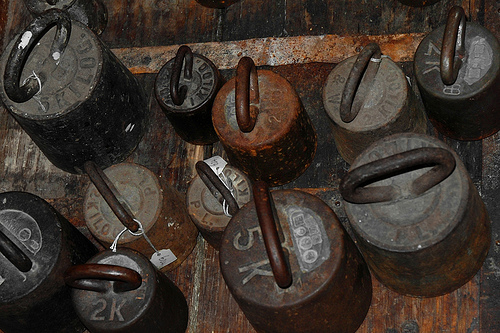
In my mind, these rusted weights have a kind of wabi-sabi that pristine fitness equipment can't replicate:


That simplicity carries over to nutrition as well.  To me the same wabi-sabi concept can be felt in good, simple food – not too much of it – well-prepared and savoured.  A steaming bowl of sautéed greens, fish, boiled eggs; a cup of plain tea – rather than protein powders and ‘engineered’ meal replacements, or worse yet mass-produced pizza pockets and frozen dinners.


In its appreciation for imperfections, I think that wabi-sabi has important connotations for fitness as well.  It leads to an acceptance of ageing as a natural evolution, but not in any sense of giving-up. Rather, it’s an aesthetic appreciation of how a constantly-challenged and well-taken-care-of body changes, and how there’s no need to camouflage the progression of time with plastic surgery or other artificial means.  It’s the kind of strength that can only come as a result of hard work, experience and a refusal to take short-cuts – the kind that can’t be faked.


Furthermore, by the apprehension of wabi-sabi, one cannot avoid the sense that life is fragile, fleeting and sometimes all too brief.  That reminder, that all things (pain and discomfort included) are temporary, can be important motivation to squeeze out that one last rep, or to simply get up off the couch.  If that’s not an admonition to carpe diem, I don’t know what is.

The sound of the Gion Shôja bells echoes the impermanence of all things;
the color of the sâla flowers reveals the truth that the prosperous must decline.
The proud do not endure, they are like a dream on a spring night;
the mighty fall at last, they are as dust before the wind.

     - The Tale of the Heike (trans. by H.C. McCullough)


Wednesday, 21 November 2012

Rush hour


This was the view from my commute this morning:


Morning mist was just dissipating over the Ottawa River – temperature hovering around zero.  It was a beautiful ride.  I don’t have the chance to bike in to work every day – It’s probably twice per week on average, more in the summer and less in the dead of winter.  I used to much more consistent before having kids.  That’s not meant as an excuse – just that with one child in school and the other in daycare at different places, it’s often impossible to swing it with my wife’s and my work schedules.  However, the days when schedules do allow it, result in the best possible commutes.  Today’s was a roughly 18 kilometre ride.  The particular route allows me to spend 95% of the time on pathways as opposed to roads – most of it right along the river (Ottawa is a great city for pathways and greenspace – but I’ve seen many other great examples too).  It’s longer, but safer, and the scenery speaks for itself.

I can’t express how much better the morning feels after a bicycle commute, rather than a drive.  Aside from the gorgeous scenery, it’s probably the best time of my day for reflection, formulating ideas, etc.  Kind of a moving meditation, which I find I’m much better at than the seated kind.  It’s a bit different in traffic (which is sometimes the route I take) – in which case allowing the mind to wander is done at one’s own peril.  However, there’s a certain zen to that, I find – to not allowing your mind to wander to anything else – redirecting, as needed, back to the pavement, the cars, lights, pedestrians.  It makes a person realize how few opportunities we (well, I can only really speak for myself) to really focus on one thing, rather than multitasking. 

I ride pretty easy on my way in to work, so I don’t have to waste time with a second shower once there.  It’s still a decent workout though – well, not a real workout per se, but at least better than sitting around.   The other metabolic advantage is that it’s done in a fasted state, so it’s a good fat-burner.  I tend to follow a Leangains-style intermittent fasting eating pattern (i.e. I fast for roughly 16 hours per day with an 8 hour eating window).  That means that I don’t eat until about 1 or 2pm, and stop around 9-10pm.  So a morning commute is done while fasting.  It forces me to do something active first thing in the morning.  I totally applaud people who can get out of bed at 5 or 6 in the morning and get a killer workout in.  I just can’t seem to do it.  Prying myself out of bed is too damn hard!  And once the kids are up, our mornings are just too busy with getting them dressed and fed and off to school/daycare.  My best option is a lunch hour workout (more on that in a future post), whereby I can train in a fasted state and then eat my first meal of the day in the early afternoon.  But a morning bike commute is a good alternate/additional option because it allows you to get an easy workout in during time that was already accounted for anyway.

I get to work feeling more energetic, less stressed and appreciative of a little bit of time spent in nature.  It saves money too, that would otherwise be spent on gas, maintenance, parking, transit fees, etc.  That’s win-win in my mind. 

Monday, 19 November 2012

Don’t tell a 4-year-old something unless you want it taken literally


I’ve been a little lax with the sprinting of late, so I took my kids down to the local sports field yesterday afternoon for a bit of wheelbarrow racing (See the Hobo Prowler Sled post).  Now, if you’re questioning whether or not to do this type of exercise, let me just say that the bewildered looks that one gets from passing motorists (I have to push them a few blocks to get to the field), while pushing two little helmeted toddlers in a wheelbarrow, are worth the price of admission on their own.

Yesterday I started off by doing end-to-end sprints (close to 100 metres I guess) with both kids in the wheelbarrow.  These don’t sound like much but, let me tell you, I’m totally gassed at the end of one of them and need a minute or two to recover before doing another.  4-year-olds are of course known for their patience, so I made the mistake of telling my daughter, immediately after one sprint, “Hold on, Daddy just needs 10 seconds to rest.”  Well, she took that as a signal to start the clock, “1, 2, 3, 4…10, ready, set, go!).  And she counts fast too!  So then I was off again, sucking in some icy November air and trying not to slow down before reaching the other end of the field.  

After about 8 of these, I was done.  But I learned an important lesson.  I don’t usually strictly police my own rest periods and, I imagine as a result, sometimes take a little bit more time than needed.  Of course, I train alone, and when doing sets of 10X3 deadlifts or squats I can do a pretty good job of calculating when I’m recovered enough for the next set.  But it’s a bit haphazard.  That problem is compounded if you lift in a gym, where there are other distractions like water fountains, conversations with other people, etc.  Just something to pay attention to, unless you want to bring a tyrannical and merciless 4-year-old girl around with you to all of your workouts.

After this, I got the kids out of the wheelbarrow and we did a few lengths of the field chasing each other.  Then we stumbled upon a new exercise that was even more hilarious (from a kid’s perspective that is) than the first.  It involved me holding them by both wrists and basically sprinting along as fast as possible while alternating swinging them up into the air and having them touch down briefly with every sixth or seventh stride I took – kind of giving them the feeling that they were bounding along on the moon with minimal gravity.  By alternating sides each time, for me it was kind of similar to doing a diagonal kettlebell swing or reverse woodchopper each repetition - Compounded by the fact that we were running continuously.  It was hard to get them to take turns with one another, and the concept of Daddy resting between ‘sets’ was out of the question.  Finally I had to basically collapse into a heap for them to take pity on me.

All told, it was a pretty decent workout, and the kids got some good exercise in and fresh air too.  So, if you feel (like me) that you might be occasionally milking your rest periods for a bit too long, you could get a timer/stopwatch....or you could save the money and bring your kids along.

Saturday, 17 November 2012

Hunting haiku

Deer woods at grey dawn
trying to make the forest 
forget that you're here