Showing posts with label poetry. Show all posts

Sunday, 16 February 2014

Blast from the Past

I just stumbled across a poem that I wrote a long time ago....almost exactly 10 years to the day  (February 2004).  In the absence of making any kind of New Year's resolutions I thought that maybe I reflect on this and see if I'm being consistent with the kind of life I envisioned a decade ago, when I was a scraggly haired hippie, living on a farm and studying Latin poetry in graduate school.  A lot has changed obviously, but I think I still identify with the core values that I wrote about back then.  You have to get past the bad poetry, but I think i was kind of writing a manifesto of sorts on the idea of simplicity and authenticity.  As Kierkegaard wrote, "Whoever you are, eternity asks you just one thing: whether you have lived authentically or not."  The title refers to an ancient Greek political/philosophical concept roughly translated as 'self-rule', or what might be extrapolated to self-reliance or self-sufficiency (I was reading a lot of RW Emerson at the time). Some of this stuff is still what I'm trying to convey with this blog.  I.e. the real good shit in life (be that in the realm of fitness or more broadly) doesn't have to cost anything.  It isn't complicated or hard to grasp.  It's right in front of you at all times, if you care to see it.  I look at this poem now and I see a lot that still resonates with me today.  When I wrote this, those 'straw-haired children' were just a glimmer in my mind's eye, still many years off.  But nowadays, with them 5 and 3-years-old and growing so fast (although only one has blonde hair), I still can't think of a happier way to spend a day than sitting beside them, putting worms on hooks and tossing lines into the water.


Autarcheia
Split wood, blow life into woolen hands,
frosty beard.
Stalk deer in the crackling dawn
of November.
Study overnight cottontail triad prints in the soft powder,
piecing together the scene.
Drink Lapsang Souchong on a stump in the vernal woods.
Wade swift trout streams with your straw-haired children.
Gather cattail pollen by bicycle, shaking seedheads into Tupperware,
Bake golden bread.
Sprout mung beans and lentils in glass jars on the windowsill.
Build a stanchion from scrap wood,
To milk your goats.
Pick beets and kohlrabi,
Steam and eat with butter.
Gather acorns from the white oak, boil out the tannins
Several times.
Learn to carve wood like your grandfather.
Build wind turbines like your great-uncle did
In dust bowl Saskatchewan nineteen thirties,
Outta the rear axle of an old Ford van.
Learn the plants,
Gather mallows as Hesiod did, and lamb’s quarters,
Mint for headaches, wild ginger for the stomach,
Plantain and spotted touch-me-not for stings.
Clip fiery blossoms of staghorn sumac,
For sun tea, sweetened with honey from your hives.
Plant a Linden tree for the bees,
Learn the craft from Aristaeus,
Smoke from burnt sumac calms them.
Waft sunset clove cigarettes,
Reclining on porch steps.
Learn the language of birds,
Coverse with crickets in the dewy crepuscule.
Re-use everything.
Catch rainwater in beautiful glass vessels.
Save seeds.
Scribble poems on rafters,
Read Milton by firelight,
Watching wax drip from the candelabra.
Shudder beneath Orion
And the inky black of January skies
To glimpse chimney smoke and the brilliance
Of undulating snowbanks refracting the moonlight.
Make noontime love in the summer grass
Backs of your knees sweating.
Take long hesperial walks along dusty roads,
Holding your wife’s slender hand.
Feed your chickens
Grains and crushed eggshells, like your grandmother said to.
Cut lilac sprigs for the kitchen table
Stain your teeth violet
With wild grape wine
And howl at the coyotes.
Value simplicity.

- DB (2004)

Tuesday, 9 April 2013

the Haiku workout


I’ve been feeling quite poetic lately for some reason. For me, that impetus is always a bit sporadic and tends to ebb away into more staid and pedantic periods, so I’m going to seize this chance to draw some parallels between poetry and exercise. For the moment, I want to focus on the Haiku form (and related Japanese-derived short poetry like Senryu and Tanka), and what that particular aesthetic or impulse might have to teach us in the realm of fitness and physical expression. I’ve always really loved Haiku. The form sometimes gets disparaged a bit for being simplistic and childish (two things which I am, proudly), but the really great Haiku poems are something magical. On the surface they seem so simple – something that anyone could do – but they also somehow hint at the totality of existence within those 3 lines of text. It’s that universality that William Blake was talking about when he wrote “to see a world in a grain of sand.” I hate to over-intellectualize any of this, because Haiku is the complete opposite of that. At its heart, it pure, unprocessed, direct experience of a fleeting moment, before our brains have a chance to apply any critical or reflective lens. The idea really resists explanation, and is probably best conveyed through examples (of some of my favourites):

On the fifteenth floor
the dog chews a bone-
Screech of taxicabs.
      -Alan Ginsberg


In my old home
which I forsook, the cherries
are in bloom.
     -Kobayashi Issa


Right at my feet
and when did you get here,
snail?
     -Kobayashi Issa

No one travels
Along this way but I,
This autumn evening.
     - Matsuo Basho


Because of the brevity, it’s important that every word has a purpose. There can be nothing extraneous. The purpose is not to reflect or deconstruct. Great haiku are those that just provide that spark, that instant of direct experience with the ineffable or sublime. They capture those moments when a person is just thunderstruck by the beauty of everything – sometimes a sad, melancholic sort, but beauty nonetheless. And hopefully, when done right, that spark triggers something in the reader almost as powerfully as in the perceiver himself, through some kind of shared cosmic consciousness or something.  So, you might ask, what bearing does this have on your next workout? Well, funny you should ask that grasshopper. I think that the ideal workout shares some commonalities with a great haiku poem. Such as:

1. It is brief. Now this isn’t to say that there’s no place for endurance work. There is (occasionally)…but I really feel that the majority of workouts should be short and intense. It’s pretty well documented that after about the 30 minute mark (of weightlifting for example) hormone levels take a rather nasty turn toward higher cortisol and lower testosterone production. Not good, not good. Few of my workouts last longer than 30 minutes. If it’s strictly weights, that means maybe 8x3 (Rookie Journal is a proponent of this and it’s really helped me increase poundages) of either squats or deadlifts, or perhaps 4-5 sets of reverse pyramid training, a la Leangains. Either way, the workout focuses on one big compound movement with minimal, if any, auxiliary work. You don’t need to do leg curls and lunges and extensions afterwards. Just squat (or deadlift, bench, etc.) and get out. With good chunks of rest between sets for recovery, that usually ends up at between 25-35 minutes per session. Structuring workouts around a single, comprehensive multi-joint movement like this allows, or rather forces me to focus on one thing and doing that one thing well. That’s the essence of haiku right there, I think. Removing distractions and focusing on only what the universe is doing right at the singular point where you are now. There’s nothing like a trying to force out a 20-rep final RPT set of back squats to remind a person of exactly where they are!

2. It’s intense
– staggeringly so. Just like a great haiku leaves the reader almost breathless by the beauty and poignancy of the image, so to should a great workout leave a person breathless (and floored, quite literally). I know I’ve done my best when I literally collapse onto the cold concrete of my garage floor after the final set. That’s the sort of intensity I aim for. That’s not to say I’m successful every time, because I’m certainly not. But I attempt to bring that intensity every time. In my mind, one shouldn’t approach a workout in any sort of half-assed way. That’s when you’re liable to get hurt or, at the very least have your progress stalled.

Building on the brevity point above, some Crossfit-style workouts or other metabolic conditioning-type work is so intense that it must, by necessity, be brief. I did ‘Helen’ for the first time last weekend, which is one of the sort of benchmarking Crossfit workouts. It took me about 13 minutes (which sucks by the way!), and at the end of it there was no way I was doing anything else. For the highly skilled people who do that workout sub-10 minutes, the intensity is even higher. The point is, like the haiku, the intensity is such that nothing further is required. In the poem, the image and sentiment is conveyed, powerfully and succinctly. It requires nothing further. The intensity of a great workout demands that there is nothing further.

3. It’s simple. I’ve made my best progress with routines of this sort. I made the mistake in my younger years of copying workouts out of muscle magazines and the like. I used to believe things such as needing to do multiple curl variations to target the different heads of my biceps. Those kinds of things might be necessary for elite level bodybuilders who are jammed full of chemical assistance and desperate to get one additional striation somewhere. For the rest of us, just do chin-ups! Your biceps will get enough work, along with your back, core, shoulders and even chest. Once that’s easy, strap on a weighted belt. No one who’s able to rep out chin-ups with 100lbs hanging off their waist is going to suffer from small biceps.

Movements like the squat, deadlift, muscle-up, rope climb, sprint, etc. are, like the haiku, almost perfect in their completeness. They’re a microcosm of human movement patterns in one package, just as the haiku is a microcosm of nature (or at least the human experience of it) in seventeen syllables. But simple doesn’t imply easy. Just as it’s extremely difficult to fully convey an experience through 3 lines of verse, these types of exercises are extremely difficult because they require the whole body working together in concert, rather than isolated muscles. And because they are so hard, many people avoid them and instead fall prey to the temptation (propagated by those wanting to sell magazines and training sessions) to do more, less-effective things. In my mind, for both exercise and poetry, improving should be about paring down and eliminating the non-essentials, rather than adding more complexity. There’s great beauty in economy, whether it be a perfect line of verse or a flawless heavy back squat.

4. It provides a new perspective.
A good haiku changes the reader in the sense that it recalls some past experience and forces a new way of looking at it, or provides a glimpse into something universal. A great workout provides a new perspective in the sense that it changes the person doing it - Not only physically (hopefully, in terms of anabolic adaptation) but also mentally/psychologically. Moving a weight that you were unable to only a week or a month prior is transformational. It changes a person’s self-perception of what they’re capable, and that has reverberations in all other facets of life. Of course progress isn’t linear and there is always going to be failure. But as Henry Rollins made clear, sometimes the kindest thing that the iron can do for you is to not budge. Failure is a great teacher in the sense that it forces a reexamination of technique, preparation, mindset, etc. to ensure that it doesn’t happen the next time.

Transformational moments like these are memorable. I still can recall the exact time and place when, for whatever reason, a particular haiku has resonated with me. And of course, for the author, that instant of composition is supremely memorable. So to, I still remember certain transformational fitness milestones – first muscle-up, first time benching bodyweight, first handstand pushup, etc. Even seemingly small improvements are often transformatively significant. Today, for instance, I strung together 10 consecutive muscle-ups. Not exactly world-class and only a one-rep improvement from my previous max, but to me it’s significant. To me it matters because expands my view of what I’m capable of.

5. It’s frugal.
There may be some great haiku poems about Maybachs and gold toilet seats, but I haven’t read any yet. Most of the ones that I love tend to eschew any kind of material concerns. They’re about simple scenes in nature, free to everyone. Or perhaps they incorporate some basic household scenes, objects or characters. Often, poverty is an undercurrent (not the abject kind but more of a simplicity associated by having only the essentially requisites of life and no more).

I got a great workout this past Saturday by doing sprints down at the local soccer field while pushing my kids in the wheelbarrow. There was another little girl there with her dad and once she got playing with my daughter she, of course, wanted to go for a wheelbarrow ride as well. With all three kids in there, it probably ended up being about 120lbs or so. And let me tell you that after about 8-10 sprints of roughly 100 yards, I was done like dinner! And all it required was a sunny day, an old rusty farming implement (which I originally found on the side of the road being thrown away), and three smiling kids yelling “One more time! Fastest ever!” No fancy equipment or expensive gear required. Actually, I was in jeans.

Perhaps that’s also why the most satisfying workouts are often those done outside, amongst the wilder elements of nature – a trail sprint up a mountainside or a swim through whitewater or the open ocean, for instance. Those ancient Greeks were onto something with their outdoor arenas and training grounds. Something about the minimalism of it all and the exposure to nature in all its wild vicissitudes.

above the moor
not attached to anything
a skylark singing
             -Basho

On one hand, these things make us feel small and humble, but also that we’re a not insignificant part of something larger.

Friday, 23 November 2012

Wabi-Sabi Fitness


I just read an excellent article on the Japanese concept of Wabi-Sabi.  It’s a concept that has fascinated me for a long time, and this provides a really succinct and thoughtful summary. Wabi-Sabi is a sentiment that I think is often felt by westerners as well (i.e. it’s universal to the human experience), but not well-articulated here because we don’t tend to have the vocabulary or the cultural context to capture it.  To me, it’s the aesthetic beauty - a kind of sad, melancholic beauty - to things that are transient and fleeting.  It carries over into an appreciation of the simple, rustic, humble, weathered and imperfect.  It’s the antithesis of the mass-produced, homogenous, throw-away products that are so common to modern culture – ironically, perhaps, since so much of those products are imported from Asia, where the Wabi-Sabi concept arose.  At its root I think is also a feeling of authenticity or naturalness, in contrast to artifice or something being contrived.

With the cherry blossoms gone
        The temple is glimpsed
                 Through twigs and branches.
                                 - Yosa Buson

For me, it’s always been that almost ineffable feeling that is produced by great haiku poems; or the beauty of an old crumbling stone wall, covered in different hues of green mosses; the a flight of departing geese at sunset; fragile, faded photographs; dew-covered spiderwebs at dawn.  It’s the somewhat pleasant feeling that things are beautiful because they are ephemeral – they exist only for a time.  And while it’s often in nature that these feelings are aroused, I think it can also be felt amongst urban decay:  a crumbling graffiti-covered wall; pigeons roosting in the eaves of buildings, old books piled high in second-hand bookshops, rust-stained concrete.
The concept is not exclusively Japanese, although it’s perhaps most beautifully captured through the aesthetics of zen rock gardens, tea ceremony, calligraphy and ink painting.  The Roman Emperor Marcus Aurelius felt it similarly when he wrote:

"Watch well the grace and charm that belong even to the consequents of nature's work. The cracks for instance and crevices in bread-crust, though in a sense flaws in the baking, yet have a fitness of their own....In ripe olives the very nearness of decay adds its own beauty to the fruit.  The bending ears of corn, the lion's scowl, the foam that drips from the wild boar's mouth, and many other things, though in themselves far from beautiful, yet looked at as consequents of nature's handiwork, add new beauty and appeal to the soul..."
                                                                                            - to Himself, Book III

Compare, in the Iliad, how the gods are envious of mortals for the precise reason that their lives are beautiful because they are so brief.  It also shows up in the Hellenistic Baroque period of art, when sculptors turned their attention away from the perfect, ageless forms of Greece’s Classical Age to explore subjects that were more flawed – an aged fisherman bringing in his catch; a battered boxer, scarred from his numerous victories; an old woman, with her deeply lined face.   

I think that the beauty of these things is that they remind us, in a gentle, sad way, or our own mortality and of the transience that we share with all of nature – the implacability of time and decay, and thus the admonition to squeeze every last drop out of the time that is given to us.
It’s a rebellion also against materialism, or that is to say against the constant churn of acquisition and disposal of material goods.  And therefore it seems to be focused on simplicity, austerity, sparseness and poverty (not in the negative sense, but in the sense of only having what one needs and nothing more) – on economy.  It is contingent upon the recognition, as in the Old English poem The Wanderer, that all material or worldly ‘success’ is only lent, and can vanish as quickly as it came:

"Wealth is lent us, friends are lent us, 
man is lent, kin is lent, 
and all the frame of the earth
shall stand empty" 

Han Shan, in his Cold Mountain poems writes about the pleasant simplicity that comes with this recognition of impermanence:

"A thatched hut is home for a country man;
Horse and carriage seldom pass my gate;
Forests so still all the birds come to roost;
Broad valley streams always full of fish.
I pick wild fruit in hand with my child ,
Till the hillside fields with my wife.
And in my house what do I have?
Only a bed piled high with books."  

How might all of this apply to fitness and training, you might ask (and rightfully so since that’s the subject of this blog)?  In several ways, I think, and firstly in the concept of economy and simplicity.  Good health and fitness need not be complicated.  It doesn’t require fancy machines and gadgets.  Often all that requires is a person’s own bodyweight and willpower.  To me, pull-ups done on a piece of old scaffolding or a tree branch have wabi-sabi; lat pull-downs done in an air-conditioned gym do not.  


Going for a run in the rain and snow, subjecting oneself to the vagaries of mother nature, has wabi-sabi; running on a treadmill does not.  Utilizing found objects (old tires, sandbags, sledgehammers, cinder blocks, my favourite wheelbarrow, etc.) rather than the latest, greatest, hermetically-sealed and sanitized fitness equipment – these things evoke the same feeling of simplicity.  Compare, in Rocky IV – Rocky training in the old barn in the snow, carrying logs, hauling wood - versus Drago training in the state-of-the-art gym.   


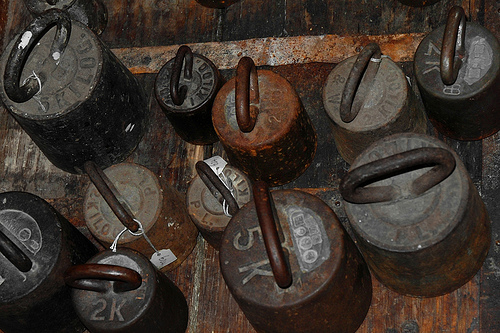
In my mind, these rusted weights have a kind of wabi-sabi that pristine fitness equipment can't replicate:


That simplicity carries over to nutrition as well.  To me the same wabi-sabi concept can be felt in good, simple food – not too much of it – well-prepared and savoured.  A steaming bowl of sautéed greens, fish, boiled eggs; a cup of plain tea – rather than protein powders and ‘engineered’ meal replacements, or worse yet mass-produced pizza pockets and frozen dinners.


In its appreciation for imperfections, I think that wabi-sabi has important connotations for fitness as well.  It leads to an acceptance of ageing as a natural evolution, but not in any sense of giving-up. Rather, it’s an aesthetic appreciation of how a constantly-challenged and well-taken-care-of body changes, and how there’s no need to camouflage the progression of time with plastic surgery or other artificial means.  It’s the kind of strength that can only come as a result of hard work, experience and a refusal to take short-cuts – the kind that can’t be faked.


Furthermore, by the apprehension of wabi-sabi, one cannot avoid the sense that life is fragile, fleeting and sometimes all too brief.  That reminder, that all things (pain and discomfort included) are temporary, can be important motivation to squeeze out that one last rep, or to simply get up off the couch.  If that’s not an admonition to carpe diem, I don’t know what is.

The sound of the Gion Shôja bells echoes the impermanence of all things;
the color of the sâla flowers reveals the truth that the prosperous must decline.
The proud do not endure, they are like a dream on a spring night;
the mighty fall at last, they are as dust before the wind.

     - The Tale of the Heike (trans. by H.C. McCullough)


Saturday, 17 November 2012

Hunting haiku

Deer woods at grey dawn
trying to make the forest 
forget that you're here

Wednesday, 14 November 2012

Thankfulness


With American Thanksgiving coming up, I thought it would be an appropriate time to share some poetry.  Unfortunately I'm not very good at it, but it makes me happy so I do it anyway sometimes. 

The Duty of Thankfulness

What fearsome focus to the task,
embrace of torn sinew,
gratitude for the exquisite ache
of exertion,
of failure,
of mere ontogeny,
is owed
to those innocent lives born each minute
into nothing more than a few brief moments
of pain and fear, baffling cruelty.
What glorious fortune
to possess limbs to grip iron,
lungs to burn icy vapour,
blood to shed,
sweat to anoint,
this holy gift,
this admonition.